TRADE & ECONOMY
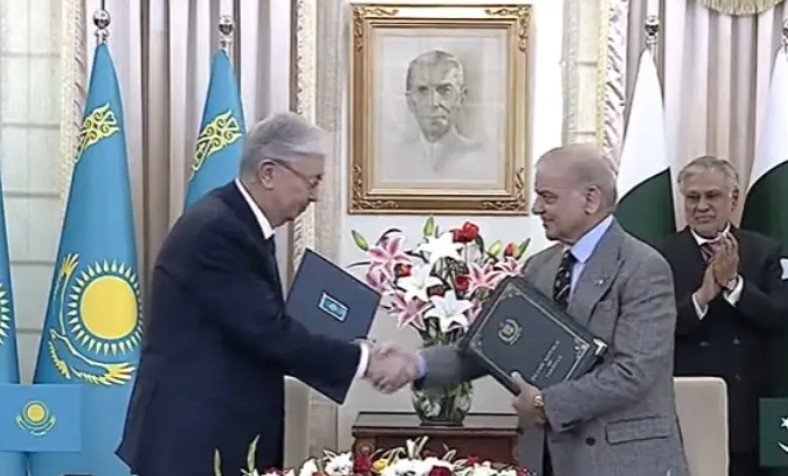
Pakistan and Kazakhstan have committed to significantly expand their economic, trade, and strategic ties, with Prime Minister Shehbaz Sharif vowing to raise bilateral trade to $1 billion within the next year. The announcement came as Kazakhstan’s President Kassym-Jomart Tokayev concluded a two-day official visit to Islamabad, the first by a Kazakh leader in 23 years.
During a joint press conference, the leaders celebrated the signing of 27 agreements and Memorandums of Understanding (MoUs) in key sectors including petroleum, mining, maritime affairs, agriculture, energy, and digital technology.
Historic Engagements and Strategic Partnership
PM Shehbaz highlighted that Pakistan and Kazakhstan’s trade volume last year stood at $250 million, far below the potential of the two nations. “If we are to make these MoUs a reality, our economic, trade, and cultural relations will go notches higher,” he said, urging business communities from both sides to pursue joint ventures.
President Tokayev termed Pakistan a “reliable and important partner in South Asia and beyond,” noting that the nations share centuries-old ties rooted in the Silk Road and common cultural, spiritual, and economic interests. He welcomed Pakistan’s participation in regional transport and logistics projects, including the Kazakhstan-Turkmenistan-Afghanistan-Pakistan corridor, which aims to boost trade connectivity.
Trade, Infrastructure, and Investment
Both leaders emphasized transforming the bilateral relationship into robust commercial and business cooperation. PM Shehbaz pledged Pakistan’s support for Kazakhstan’s access to Gwadar and Karachi ports, while Tokayev invited Pakistani companies to invest in Kazakhstan’s industrial and agricultural sectors.
The two countries also agreed to explore the resumption of direct air connections and to strengthen cooperation in energy, including the Turkmenistan-Afghanistan-Pakistan-India (TAPI) gas pipeline. Joint projects in the defence and digital technology sectors were also highlighted, with an emphasis on AI, innovation, and digital transformation as future drivers of economic growth.
Education and People-to-People Ties
President Tokayev noted that over 1,000 Pakistani students are currently studying in Kazakhstan. Both nations agreed to foster cooperation in research, education, and culture, including the establishment of formal relations between leading institutions in both countries.
Business Forum and Future Roadmap
At the Pakistan-Kazakhstan Business Forum, PM Shehbaz and Tokayev underscored the need for structured business-to-business engagement. Over 250 companies from both countries are expected to sign commercial agreements in the near future, unlocking new avenues for trade, investment, and joint production.
A working group will be formed to develop a five-year programme to boost commerce, trade, and investment. Pakistan’s Dr Ahsan Iqbal and Kazakh Deputy Prime Minister Serik Zhumangarin will co-lead the initiative, setting the framework for achieving the $1 billion trade target even sooner than planned.
Regional Significance
The visit also underscores Pakistan’s strategic role as a regional land bridge between Central and South Asia. Enhanced connectivity via rail, road, and seaports positions both countries to tap into broader markets, diversify trade, and strengthen regional economic integration amid global challenges, including the ongoing Eurasian turbulence following the Russia-Ukraine conflict.
The two nations reaffirmed their shared commitment to a “strategic partnership,” marking a turning point in bilateral cooperation and setting the stage for long-term economic, educational, and technological collaboration.
-
Rising Global Oil Prices Trigger Forex Strain in P...
Pakistan faces forex pressure in oil imports as global prices surge past $130/barrel. Govt...
-
Pakistan Fully Secured on Fuel Supplies, PM Assure...
Pakistan has sufficient petrol for 27 days and diesel for 21, PM Shehbaz Sharif says. Govt...

-
Pakistani Oil Tanker ‘Karachi’ Crosses Strait ...
The PNSC tanker ‘Karachi’ safely crosses the Strait of Hormuz toward Pakistan despite ...

-
Pakistan Has Petrol for 27 Days, Diesel for 21 Day...
Pakistan has petrol reserves for 27 days and diesel for 21 days, Petroleum Secretary Hamed...
-
KSE-100 Index Plunges 4,687 Points Amid Oil Price ...
Pakistan’s KSE-100 index tumbled 4,687 points (-3.05%) on Monday, extending its losing s...