WORLD NEWS
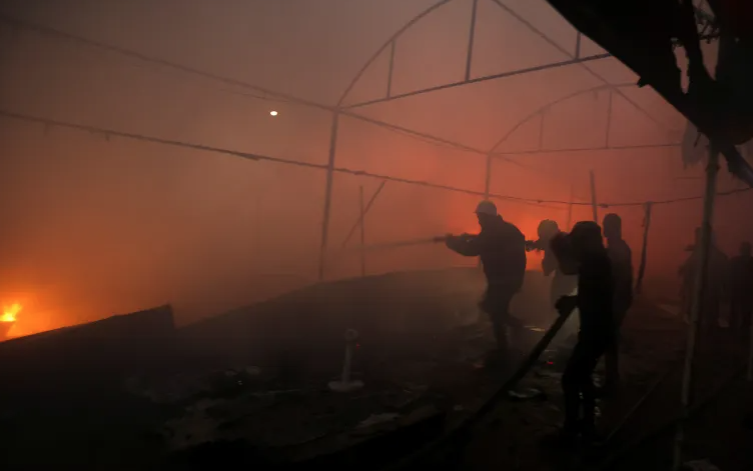
At dawn on August 10, 2024, Yasmin Mahani walked through the smoking ruins of al-Tabin school in Gaza City, desperately searching for her son, Saad. She found her husband screaming amid the wreckage, but there was no sign of their child.
“I went into the mosque and found myself stepping on flesh and blood,” Mahani told Al Jazeera Arabic during an investigation aired on Monday. For days, she searched hospitals and morgues. “We found nothing of Saad. Not even a body to bury. That was the hardest part.”
Mahani is among thousands of Palestinians whose relatives have disappeared during Israel’s ongoing war on Gaza, which has killed more than 72,000 people since October 2023.
According to Gaza’s Civil Defence, 2,842 Palestinians have “evaporated” during Israeli strikes — leaving behind no recoverable remains other than blood spray or small fragments of flesh.
Civil Defence spokesperson Mahmoud Basal said the figure is the result of meticulous forensic documentation rather than estimation. “We enter a targeted home and cross-reference the known number of occupants with the bodies recovered,” he explained.
“If a family tells us there were five people inside, and we only recover three intact bodies, we treat the remaining two as ‘evaporated’ only after an exhaustive search yields nothing but biological traces,” Basal said.
Weapons and extreme heat
Experts and witnesses interviewed in the investigation attributed the phenomenon to the use of thermal and thermobaric weapons, often referred to as vacuum or aerosol bombs, which are capable of generating temperatures exceeding 3,500 degrees Celsius.
Russian military expert Vasily Fatigarov explained that such weapons do not merely kill but obliterate matter. “These munitions disperse a cloud of fuel that ignites into a massive fireball, creating both extreme heat and a vacuum effect,” he said.
“To prolong the burning time, aluminium, magnesium, and titanium powders are added, raising the explosion temperature to between 2,500 and 3,000 degrees Celsius,” Fatigarov added.
The investigation linked this effect to explosives such as tritonal — a mixture of TNT and aluminium powder — used in US-manufactured bombs like the MK-84.
Dr Munir al-Bursh, director general of Gaza’s Ministry of Health, described the biological impact of such heat. “The human body is about 80 percent water. When exposed to temperatures exceeding 3,000 degrees combined with massive pressure, fluids boil instantly and tissues vaporise. It is chemically inevitable,” he said.
Munitions identified
The investigation identified several US-made weapons allegedly used in Gaza:
- MK-84 “Hammer” bomb: A 900kg unguided bomb generating heat up to 3,500C.
- BLU-109 bunker buster: Used in al-Mawasi — an area designated by Israel as a “safe zone” — where 22 people were reportedly incinerated in September 2024.
- GBU-39 glide bomb: Used in the al-Tabin school strike, designed to destroy everything inside a structure while leaving the exterior largely intact.
Basal confirmed that fragments of GBU-39 wings were found at sites where bodies could not be recovered.
Legal concerns and accountability
Legal experts say the alleged use of such weapons raises serious international law concerns. Diana Buttu, a lawyer and lecturer at Georgetown University in Qatar, described the situation as a case of shared responsibility.
“This is a global genocide, not just an Israeli one,” she said at the Al Jazeera Forum in Doha, pointing to the continued supply of weapons from the United States and Europe.
“Under international law, weapons that cannot distinguish between combatants and civilians constitute war crimes,” Buttu added.
Despite provisional measures issued by the International Court of Justice in January 2024 and an arrest warrant issued by the International Criminal Court against Israeli Prime Minister Benjamin Netanyahu in November 2024, the violence has continued.
International law professor Tariq Shandab said the justice system had “failed the test of Gaza,” noting that hundreds of Palestinians have been killed even after ceasefire agreements.
“The blockade on food and medicine is itself a crime against humanity,” he said, while adding that universal jurisdiction courts in Europe could offer a path to accountability if political will exists.
For survivors like Rafiq Badran, legal terminology offers little comfort. He lost four children in an air strike on the Bureij refugee camp.
“Four of my children just evaporated,” he said. “I searched for them again and again. Not a piece was left. Where did they go?”
-
Iran Signals Flexibility on Uranium Enrichment Ami...
Iran’s Ali Larijani meets Oman’s Sultan to advance nuclear talks with the US. Tehran s...
-
Macron Warns Europe to Brace for More U.S. Hostili...
French President Emmanuel Macron calls on the EU to learn from the "Greenland moment," str...
-
Minnesota Woman Arrested After Following ICE Agent...
Becky Ringstrom, a mother of seven, was arrested in Minneapolis after following federal im...
-
Starmer Survives Internal Challenge Amid Epstein-M...
UK PM Keir Starmer survives calls to resign after revelations about Peter Mandelson’s ti...

-
Iran Warns of ‘Destructive’ Influence Ahead of...
Iran warns that Israel is undermining regional diplomacy ahead of PM Netanyahu’s Washing...