WORLD NEWS
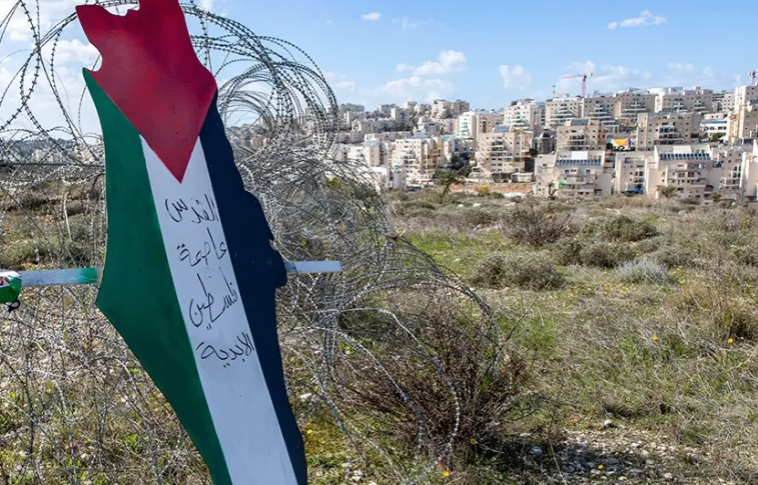
Israel is preparing to advance two major illegal settlement projects in occupied East Jerusalem, a move Palestinian officials and experts warn could decisively undermine any prospect of a contiguous Palestinian state with East Jerusalem as its capital.
According to the Jerusalem governorate, Israeli authorities are set to discuss approving 9,000 settlement units on the site of the former Qalandiya airport, also known as Atarot, as well as a separate settlement plan in Sheikh Jarrah that would displace at least 40 Palestinian families.
Political analyst and settlement expert Suhail Khalilieh, speaking to Al Jazeera, said the revival of the Atarot plan — which was briefly shelved in December 2025 — is directly linked to shifting geopolitical dynamics following a recent meeting between Israeli Prime Minister Benjamin Netanyahu and US President Donald Trump.
“The meeting served as a green light for continued settlement expansion,” Khalilieh said, adding that Washington’s position treating Jerusalem as outside any negotiation process has emboldened Israeli authorities. He noted that international opposition has been reduced to “verbal objections without any deterrent effect”.
Khalilieh explained that the Atarot project is not merely a housing development but a strategic move aimed at severing Palestinian geographical continuity in the northern West Bank. He said the settlement is part of three key axes designed to realise Israel’s long-term vision of “Greater Jerusalem”.
“This will expand Jerusalem’s area by adding 175 square kilometres,” Khalilieh said. “With these additions, Israeli-controlled Greater Jerusalem will reach 246 square kilometres — about 4.5 percent of the West Bank — effectively eliminating the possibility of a Palestinian capital in East Jerusalem.”
Meanwhile, the “Nahalat Shimon” settlement plan in Sheikh Jarrah targets the area known as the Holy Basin, north of the Old City. Khalilieh said the project is part of longstanding Israeli efforts to encircle the Old City with settlements, cutting off Palestinian neighbourhoods such as Silwan, Sheikh Jarrah and the Mount of Olives from one another.
“The aim is to transform these neighbourhoods into isolated population islands,” he said, warning that intensified demolitions are being used to gradually empty Palestinian areas.
Khalilieh also accused Israeli authorities of masking forced displacement through planning terms such as “urban renewal” and “land settlement”. He noted that more than 300 Palestinian homes were demolished in East Jerusalem in 2025 alone, often under the pretext of lacking building permits.
He further highlighted the unification of the Arnona property tax, which requires Palestinians in under-serviced neighbourhoods to pay the same high rates as residents of affluent Israeli areas, increasing economic pressure to leave the city.
“This constitutes a silent forced transfer,” Khalilieh said.
Calling for urgent international action, Khalilieh stressed that intervention must occur before construction begins, as reversing facts on the ground becomes politically “nearly impossible” once projects are underway. He urged diplomatic efforts, provisional measures at the International Court of Justice (ICJ), and accountability for international companies involved in settlement construction.
“The core issue is political, not legal,” he said. “Early intervention is crucial to freeze these projects before the situation becomes irreversible.”
-
Cuba’s President Rejects US Talks, Says Only Tec...
Cuban President Miguel Díaz Canel says there are no current talks with the US beyond tech...

-
Iran Ready for War or Negotiations as Protests Sub...
Iran says it is prepared for both war and talks after weekend protests turned violent, bla...
-
Trump Floats Military Options Over Iran Protests, ...
Trump says US is weighing “strong options,” including military action, over Iran’s p...

-
Trump Insists US Will Keep Greenland; Locals Push ...
Trump says the US will keep Greenland “whether anyone likes it or not,” citing China a...

-
Turkey Warns Israel Against Exploiting Iran’s Un...
Turkey warns Israel that attempts to exploit Iran’s protests will fail, while violent de...