POLITICS & POLICY MAKING
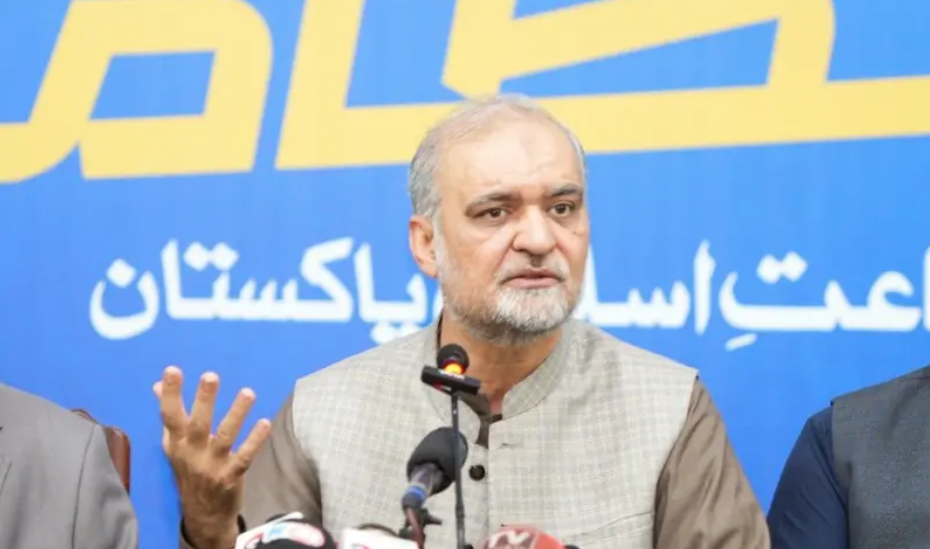
Chief of Jamaat-e-Islami (JI) Hafiz Naeemur Rehman on Saturday strongly criticised the government’s decision to participate in the inaugural meeting of the Board of Peace (BoP) on Gaza, calling the move “unacceptable at any cost.”
His remarks followed Thursday’s meeting in Washington, where Prime Minister Shehbaz Sharif praised the peacemaking efforts of United States President Donald Trump, who is leading the initiative.
Addressing a press conference in Lahore, Rehman said the government’s participation in the forum ignored Pakistan’s long-standing and consistent policy on the Palestine issue. He stressed that since the time of Muhammad Ali Jinnah, the country’s stance on Palestine had remained clear, and any deviation from that position would be intolerable.
Rehman also voiced strong opposition to any proposal to deploy Pakistani troops to Gaza under a proposed International Stabilisation Force (ISF) outlined in Trump’s 20-point peace plan. He argued that Gaza’s security and governance were internal Palestinian matters that should be handled solely by local police and security forces, not foreign military contingents.
“Under whose command will you go?” Rehman questioned, expressing scepticism about how Pakistani forces could operate under American leadership while maintaining an independent stance on Israel and the United States.
Despite the concerns raised, Pakistan was not listed among the five countries that pledged troops for the ISF, which aims to secure reconstruction zones and assist in establishing a post-conflict governance framework in Gaza. According to officials, countries including Morocco, Albania, Indonesia, Kazakhstan and Kosovo committed personnel to the proposed force. Indonesia earlier indicated readiness to contribute up to 8,000 troops.
Foreign Office spokesperson Tahir Andrabi clarified that Islamabad had outlined its “red lines,” stating Pakistan could consider participation in a peacekeeping mandate but would not engage in any disarmament or demilitarisation mission.
The JI chief also criticised the broader framework of the initiative, particularly discussions surrounding the disarmament of Hamas. The second phase of the proposed plan reportedly calls for Hamas’s disarmament — a move that has drawn mixed reactions across the region. While Trump expressed hope that force would not be required, Israeli Prime Minister Benjamin Netanyahu said Hamas would be disarmed “one way or the other.”
In a statement posted on X, the JI’s official account said the government’s decision to join what it described as a “so-called Trump peace board” without consulting Parliament, the cabinet or key stakeholders undermined national dignity and deviated from established policy.
The party urged the government instead to advocate for the Palestinian cause at the United Nations and to challenge what it called the repeated use of veto power by the United States to shield Israel from accountability over the Gaza conflict.
The proposed ISF initiative follows a ceasefire negotiated in October by the Trump administration in coordination with Qatar and Egypt, aimed at ending two years of hostilities in Gaza. Earlier this week, Trump pledged $10 billion for the enclave’s reconstruction and gathered representatives from several Muslim-majority nations to discuss funding and security arrangements.
As debate continues within Pakistan, the controversy highlights broader questions about Islamabad’s diplomatic posture, military commitments abroad, and adherence to its historic position on the Palestinian issue.
-
Rana Sanaullah Calls for Joint Anti-Terror Strateg...
Rana Sanaullah says govt and military are united against terrorism, urges PTI to engage po...
-
Dar, Azerbaijan FM Discuss Board of Peace and Gaza...
DPM Ishaq Dar and Azerbaijan FM Jeyhun Bayramov discuss bilateral ties and the inaugural B...

-
Sindh Assembly Declares Karachi an ‘Inseparable ...
Sindh Assembly passes resolution reaffirming Karachi as an inseparable part of Sindh, cond...
-
Ali Amin Gandapur Indicted in Audio Leak Case as C...
An Islamabad court has indicted PTI leader Ali Amin Gandapur and co-accused Asad Farooq Kh...
-
Defense Minister Khawaja Asif Warns Pakistan May L...
Defense Minister Khawaja Asif says India and Kabul are aligned in actions against Pakistan...