CRIME

The National Cyber Crime Investigation Agency (NCCIA) has dismantled an “international cartel” involved in cyber fraud worth an estimated $60 million, arresting 15 foreign nationals and 19 Pakistani citizens during joint raids in Karachi’s Defence Housing Authority (DHA), Sindh Home Minister Zia-ul-Hassan Lanjar revealed on Thursday.
Addressing a press conference alongside NCCIA Additional Director Tariq Nawaz, the home minister said the suspects were operating sophisticated online investment scams targeting both local and foreign victims through social media platforms. According to Lanjar, the scammers built trust with victims over weeks and months, luring them into fraudulent cryptocurrency and forex investments by promising high returns.
He explained that victims were persuaded to create logins on fake investment platforms, which appeared legitimate due to coordinated conversations and fabricated activity in Telegram groups. These platforms were fully controlled by the scammers, who regularly displayed fake profit figures to convince victims that their investments were growing.
During raids conducted in DHA Phase 1 and Phase 6 last week, law enforcement agencies recovered 37 computers, 40 mobile phones, over 10,000 international SIM cards and six unlawful gateway exchanges. Lanjar said these tools were used to create fake social media accounts and Telegram groups, generating a false audience to deceive potential investors.
The home minister added that foreign SIMs were primarily used to receive PIN codes and one-time passwords (OTPs) for creating Telegram IDs and, when necessary, to communicate via WhatsApp. He said a key part of the cartel’s operation involved managing Telegram groups and social media profiles to lure victims into investment schemes.
Another critical component of the fraud, Lanjar said, was the collection and routing of funds through bank accounts in target countries. These funds were then converted into cryptocurrency and transferred across borders to the cartel’s main beneficiaries. He disclosed that technical and financial investigations had led to further developments, which were currently under investigation.
Explaining the modus operandi, Lanjar said the scammers gave victims the illusion that their money was being invested and profits were accumulating, while in reality no funds were returned to the victims’ accounts. Once investments reached around $5,000, victims were asked to pay additional fees under various pretexts. After the payments were made, the scammers would block the victims’ accounts.
The home minister said the scale of the fraud was estimated at $60 million. He noted that he delayed addressing the media until a comprehensive investigation was completed due to the seriousness of the case and the involvement of foreign nationals from countries with which Pakistan maintains important diplomatic relations.
Lanjar said the foreign and interior ministries had taken up the matter with the concerned countries, stressing that while Pakistan provides security and facilitation to foreigners, strict legal action would be taken against anyone found involved in criminal activities. He, however, declined to disclose the nationalities of the arrested foreign suspects.
The home minister also acknowledged receiving complaints from citizens about illegal call centres being used for fraud, narcotics and other crimes. He said NCCIA centres in Hyderabad and Sukkur were also receiving similar complaints, adding that the federal government regulates call centres through no-objection certificates (NOCs).
“This issue will not be resolved with these arrests alone; we need to do more,” Lanjar said.
NCCIA Additional Director Tariq Nawaz said both locals and foreign nationals were involved in the scam, and that victims included people from Pakistan as well as abroad. “Crime has no boundaries, and the cyber world has no specific geographical locations,” he said, describing the arrests as only the “tip of the iceberg.”
On Sunday, a judicial magistrate remanded 22 suspects, including eight foreign nationals, to prison on judicial remand. NCCIA has registered cases against the accused under various provisions of the Prevention of Electronic Crimes Act (PECA) and the Pakistan Penal Code.
-
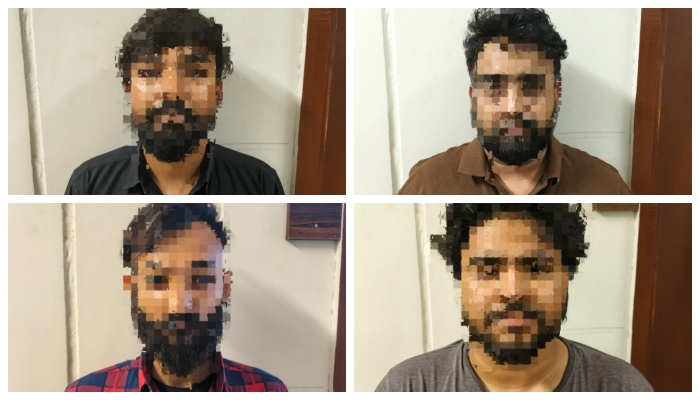
Karachi NCCI Busts Organised Scam Call Centre, 4 A...
The National Cyber Crime Investigation Agency (NCCI) Karachi raided a DHA Phase 2 Extensio...
-
Two Policemen Martyred, Dozens Injured in IED Blas...
Two policemen martyred and 22 people, including civilians and security personnel, injured ...

-
Two Policemen Martyred in Suicide Blast at Bhakkar...
A suicide blast at a checkpost in Bhakkar district kills two policemen and injures three p...
-
School Bombed in South Waziristan; No Casualties R...
Unidentified attackers blew up a government boys’ middle school in Birmal, South Waziris...

-
Petrol Bomb Thrown at Karachi AC During Encroachme...
Assistant Commissioner Hazim Bangwar survives petrol bomb attack during Karachi’s Le Mar...