WORLD NEWS
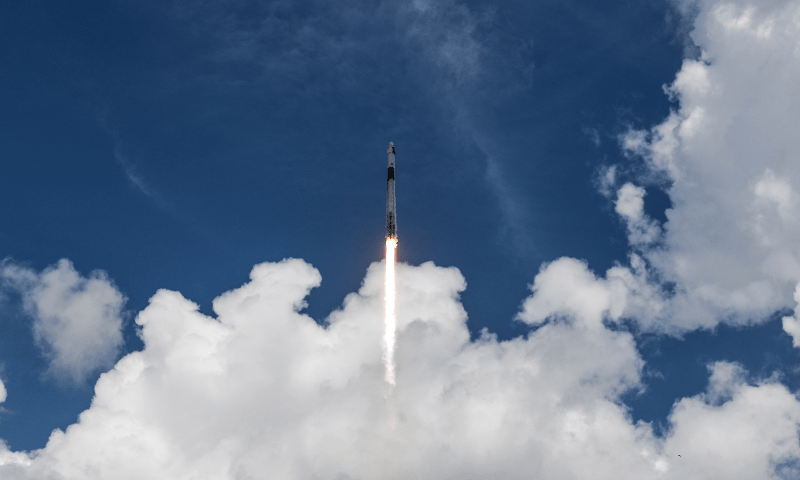
Four astronauts aboard a SpaceX Crew Dragon capsule successfully docked with the International Space Station (ISS), beginning a six-month mission packed with scientific experiments and simulations that could shape the future of lunar and Martian exploration.
“Docking confirmed!” SpaceX announced via social media at 2:27am Eastern Time (11:27am Pakistan time), posting a video of the spacecraft making contact with the ISS high above the southeast Pacific Ocean.
The international crew of four includes American astronauts Zena Cardman and Mike Fincke, Japan’s Kimiya Yui, and Russian cosmonaut Oleg Platonov. They launched on Friday from NASA’s Kennedy Space Center in Florida atop a Falcon 9 rocket.
The mission marks the 11th crew rotation flight under NASA’s Commercial Crew Programme — a public-private collaboration designed to replace the retired Space Shuttle fleet and enable reliable access to low-Earth orbit via commercial partners like SpaceX.
Shortly after docking, the current ISS crew welcomed their new colleagues with humor and warmth: “We have cold drinks, hot food, and us waiting — see you soon,” they radioed. “Hello Space Station — Crew 11 is here and we are super excited to join,” astronaut Mike Fincke responded.
During their six-month stay, the Crew-11 team will engage in a range of scientific experiments, including critical research for NASA’s Artemis programme, which aims to land astronauts on the lunar South Pole later this decade.
One key objective: simulating lunar landing scenarios in microgravity using handheld flight controllers and interactive screens to study how astronauts can operate spacecraft in different gravitational environments.
The team is also carrying unique cargo — including Armenian pomegranate seeds. These will be studied aboard the ISS to understand how microgravity affects crop growth, compared to a control batch remaining on Earth.
The International Space Station, continuously inhabited since 2000, continues to serve as a vital outpost for scientific discovery and preparation for deeper space missions. With the station scheduled for decommissioning after 2030, missions like Crew-11 offer vital insight into the future of off-planet habitation and space travel.
After its operational life, the ISS is expected to be deorbited in a controlled descent over the South Pacific Ocean’s "Point Nemo" — the remote site known as a graveyard for retired spacecraft.
-
Starmer Confirms UK Will Not Join Iran War, Emphas...
UK PM Keir Starmer vows Britain will stay out of the Iran war, focusing on diplomacy & Eur...

-
North Korean Hackers Breach Popular Software to St...
North Korean-linked hackers compromised the open-source software Axios, aiming to steal lo...

-
Assam Delimitation Redraws Muslim-Majority Seats, ...
Assam’s 2023 delimitation reshapes electoral boundaries, reducing Muslim-majority seats ...

-
Israeli Airstrikes Kill Multiple in Southern Beiru...
At least 7 killed in Israeli attacks on Beirut’s southern suburbs and nearby towns as He...

-
Qatar Warns Iran Has Crossed “Red Lines,” Call...
Qatar says Iran’s attacks on regional neighbors risk catastrophic fallout; calls for res...