“Are you sure That we are awake? It seems to me That yet we sleep, we dream.
–William Shakespeare
Winter has arrived, trees are calm, silence is everywhere, and we can see mist falling upon leaves. Karachi and Hyderabad are cities likely to see the least cold as compared to other cities of the province. Karachites, sitting in their T.V lounges talk about sports and entertainment, the cricket world cup has ended, and FIFA world cup is going on in Qatar, they talk about their favorite teams and players. It sounds exciting, no? But there is another world. A world where playing in football or cricket ground is a luxury, children of this world yearn to play their favorite games. I live in Karachi, but I am raised and born in hometown Khairpur Mirs, which is also part of the world I am going to talk about. This is the point where nostalgia starts to hit me, I remember my life in hometown, where temperature goes down to 5 to 1 degree in winter. We always welcome winter by arranging a badminton tournament with cousins in the village. Bonfire Bar-B-Q and tea gatherings are still common. I mean, life goes smooth. Now I feel it’s a luxury, we have a dry place, yes. Miseries of flood-affected people are yet to be identified, people are stranded due to monstrous monsoon floods in different parts of Sindh battling the aftermath and their life is at a standstill. They don’t think about leisure time, they don’t want to play badminton as they don’t find it more fascinating due to the pain and sorrow caused by rains in August and September, poverty has sunk them, they need shelter, warm clothes and want to bring better days they had before floods. We cannot say a better life, because before floods they had thousand other problems such as lack of medical, infrastructure and health facilities, millions of children were and are still unable to get primary and secondary education. Soaring unemployment and rise of different diseases making things worse. After floods, let’s think about children whose lives and future are at the stake, excruciatingly, their disrupted life of childhood and memories waiting to haunt them for life. Where is government? Where are international funds for flood relief?
During an interview with a French news agency, in a cozy environment, Foreign Minister Bilawal Bhutto Zardari said “Every crisis creates an opportunity and this crisis the opportunity is to build back in a most resilient way, in a greener way, we need to build green and climate resilient infrastructure”. This statement can make sense to the interviewer sitting in front of Mr. Foreign Minister but the question arises does it make sense to flood affected people? Pakistan ranked 124th in Governance and 134th in the prosperity index declared by Legatum Prosperity Index 2021. People who have battled these catastrophic floods have not been provided enough relief yet. As I was scrolling down my Twitter account I saw a trend #RehabilitateKNShah which is a town in Dadu district and is witnessing the same fate it did during the 2010 super floods and also has been the hardest hit so far this time. Mr. Bhutto whose party is ruling for 15 years is not able to assist the people of Khairpur Nathan Shah, how will he be able to rehabilitate the rest of the districts where water has not receded? Recently, I saw a tweet of Amar Fayaz Buriro who is by profession a researcher and a computational linguist posted two pictures of Pir Wassan area of Taluka Thari Mir Wah is still under water, with a caption “Beauty or Misery”. Let’s ask Foreign minister, who has not yet given roadmap that how will he utilize international funds given by international community for the relief of flood-affected people? In an interview uploaded on Fourth Pillar Post’s Youtube Channel, Ayaz Latif Palijo who is a politician, lawyer and president of Qomi Awami Tahreek, lamented, “Sindh is like a dead body, and PPP’s ministers have covered that body with a cloth, and are flaunting it in Zainab Market (A famous shopping street in Karachi) or Gul Plaza (Famous shopping place in Hyderabad), minister sitting beside the dead body begging for that body’s sake and telling world Sindh is ill, Sindh has died, people of Sindh are dead, they collect relief funds after showing dead bodies of people of Sindh and they loot.”
Moving on, I am going to recall those days, when alluring rains became a disaster. Some people said monsoon rains are a calamity foisted by God, and some severely criticize the government for their sheer negligence, corruption in the development sector, mismanagement, and poor planning. Many were asking why the government didn’t take precautionary measures. Why mass evacuations were not ordered in low-lying areas? People were confused. Who to hold accountable either Politicians, bureaucrats or local feudal, and leaders of tribes. Well, it’s not the first time the people of Sindh found themselves helpless, but this time with a heavier heart than ever before.
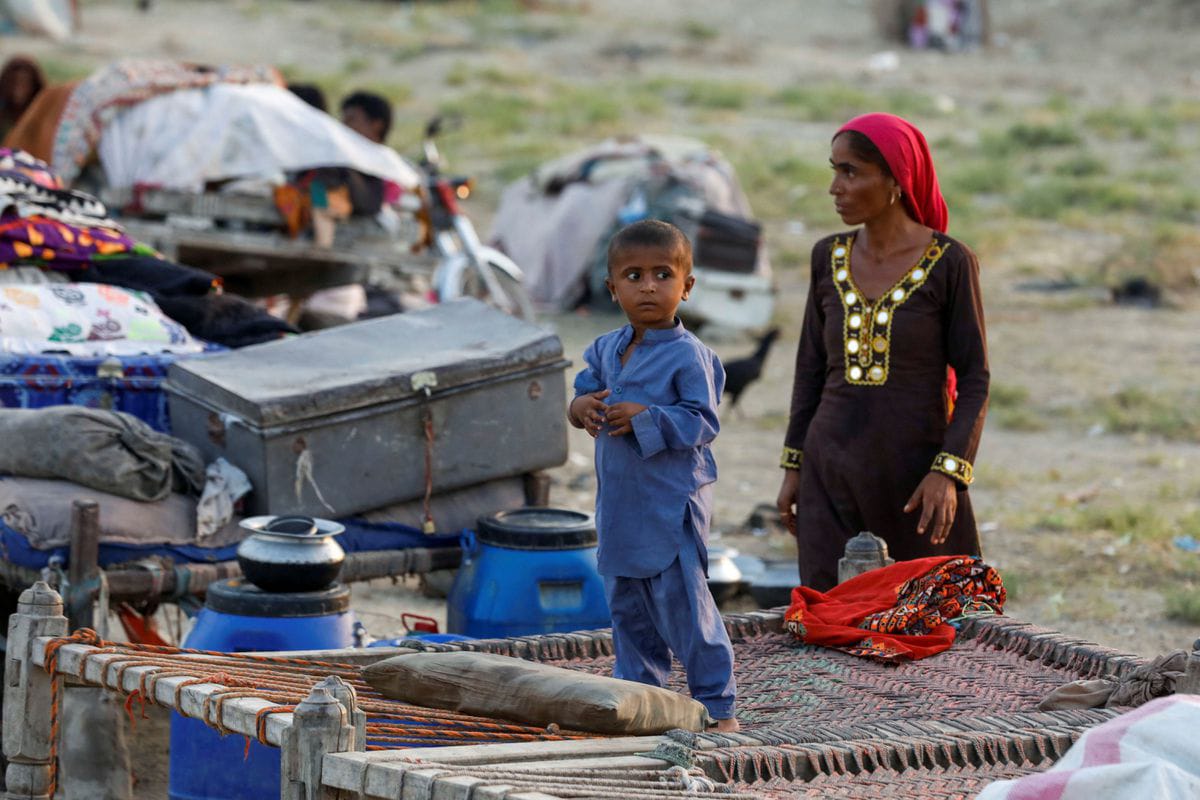
I tried to look back those days, I thought to leave for the city from my village which is about 18KM approximately, during my journey, I saw hundreds of families displaced and temporarily settled under the open sky along the roadsides in their respective towns since the rains wreaked a catastrophe. I saw children crying for milk and women cooking food on the roads. One cannot imagine happening this with their families and children. Some families had tents, but most of them had nothing to cover their charpoys and home appliances. In their home appliances, they only had a trunk where they put their precious belongings. They had goats and sheep as the only assets that remained because all their crops were drenched in rainwater. I saw Women carrying drinking water in containers and having their children crying on their shoulders fighting them to allow playing with mud to fool themselves that everything is normal. I was thinking about their childhood; childhood memories are something to cherish when a person grows up to be an adult. With teary eyes, I continued my journey and witnessed men walking on temporary bamboo paths near their flooded houses and schools surrounded by rainwater where thousands of children once dreamed to be Engineers, Doctors, or other professionals. They saw their future drowning, losing friends, and missing petty fights with their class fellows over pencils and erasers.
As days passed by, millions of people across swathes of Pakistan were wrestling the worst monsoon floods in a decade, with countless homes washed away, vital farmland destroyed, and the country's main river threatening to burst its banks. When the rain started for the first time our home was partially submerged in rainwater. I remember we immediately decided to evacuate our family and children to a less-affected place. Neighbors were struggling to prevent water from entering their homes. Water levels in low-lying areas were increasing dramatically due to flooding at Sukkur Barrage. Things were getting horrific; everyone was scared. People said we had only one option left; prayers. They were requesting authorities that we need food and milk for newly born. We need rescue. We need power and mobile signals. Also, some conspiracy theories got birth and some believed this is the result of HAARP technology.
Stranded local people along with their belongings were wading through flooded streets after fleeing from their flood-hit homes. Residents in my home district, Khairpur Mirs, rowed their boats through the chest-high water after heavy rains hit the city. There is still 2 to 3 feet of stagnant water in Kot Diji. The historical fort of Kot Diji built by the Talpur dynasty which is constructed on a limestone hill with kiln-baked bricks was damaged and it is worth mentioning that government did not move. This picturization made me thinking and questioning myself should I find people who have taken responsibility for making things better for us? I am also a rain victim. Sometimes I ask myself, what I have learned from this? Well, everyone should ask this question from him/herself. We should look at the basic question; why do we vote? I asked this question from some of my friends, colleagues, and others and the answers were quite good; for example, for better healthcare, better education, better infrastructure, and a better economy. Indeed, voting is more than just electing a candidate; it means better representation, a better quality of life, and choosing the right policies and people who have your best interests in mind when making decisions that will affect our community, state, and nation.
Civil society and social activists continue to criticize authorities. The people of Sindh are still furious, full of anger, they are in grief and showing rage against their elected MPAs and MNAs as the aftermath of the cataclysmic floods continues to unfold. According to UNICEF, an estimated 16m children are among the flood-affected population, with at least 3.4m of them in need of immediate, lifesaving support. According to PDMA, the death toll from devastating floods in Sindh soared to at least 339, and while 98,260 cattle had perished, 191,030 houses were fully damaged and 395,080 partially. The floods in Pakistan have caused huge economic damage and damage to infrastructure. More than 20 million people have been affected and around 1.8 million homes have been destroyed. More than seven million people remain in need of emergency shelter. The country's agricultural heartland has been devastated, with the destruction of date palms, cotton and wheat crops.
In conclusion, I want to reiterate the question I asked earlier, who to hold accountable? should we hold ourselves? we need to look at our enemy within, ask our hearts and mind, do we deserve change? Do we contribute enough make things easier for generations to come? This crisis may unfold a revolution, a changed perspective to look at things, politics, society, and a revamping social structure. Well, tools we can use for initiating a long-lasting way forward are: we should perish ethnic divide, the more transparency of funds in development sector, the more accountability of responsible officials, and lastly, we should focus on our responsibilities through fulfilling our civic duties. I would also say responsible people should imagine living in a flooded area having no electricity, no clean drinking water, and different diseases attacking you and your children starving, think about how helpless we became and then go for vote. I would like to request authorities, please speed up rehabilitation, this too shall pass, but government’s negligence will be remembered, the water, which haunted for months, a killer calm, which people never forget, will bring a revolution, you will never be able to go and ask for a vote. The anger of people is genuine and will make authorities pay for it.
-
Mohammad Mokhber: Iran's New Interim President, wh...
As stipulated by the country's constitution, Mokhber now steps into the role of interim pr...
.jpeg)
-
One woman dies during pregnancy every 50 minutes i...
According to UNFPA, a woman dies every 50 minutes in Pakistan due to pregnancy complicatio...
-
The most important reason for the rapid spread of ...
Cancer is a rapidly spreading disease worldwide that causes millions of deaths every year....

-
A common habit that leads to obesity despite eatin...
Gaining body weight despite eating less or exercising? So maybe this is the result of a no...

-
10 Common Symptoms That Point To Depression...
Depression is one of the most common mental illnesses, but most people do not know that th...