LEGAL
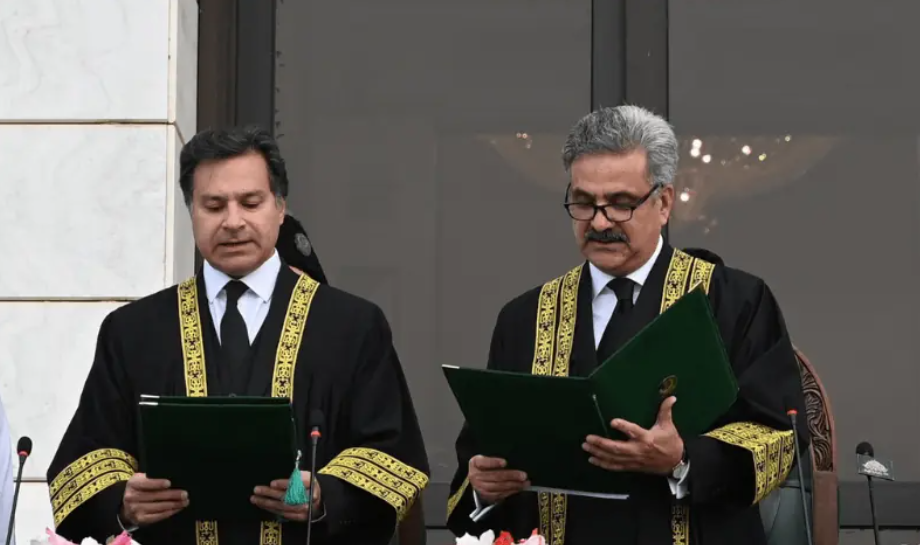
The Judicial Commission of Pakistan (JCP) on Tuesday approved the elevation of Justice Miangul Hassan Aurangzeb as a permanent judge of the Supreme Court (SC). The decision was taken during the Commission’s first meeting following the adoption of the 27th Constitutional Amendment and the creation of the Federal Constitutional Court (FCC).
Presided over by Chief Justice of Pakistan (CJP) Yahya Afridi, the JCP convened at the Supreme Court building to review several high-level judicial appointments. Justice Aurangzeb had earlier been serving as an ad hoc judge of the apex court after his elevation from the Islamabad High Court (IHC) in February.
In addition to his confirmation, the JCP approved two significant high court appointments. Justice Zafara Ahmed Rajput was selected as the next chief justice of the Sindh High Court (SHC), while Justice Kamran Mullahkhail was chosen to serve as the chief justice of the Balochistan High Court (BHC).
During the meeting, the Commission evaluated candidates for the SHC chief justice position from among the court’s three senior-most judges: Justice Rajput, Justice Muhammad Iqbal Kalohoro, and Justice Mahmood A. Khan. Similarly, for the BHC, the JCP considered Justice Mullahkhail, Justice Iqbal Ahmed Kasi, and Justice Shaukat Ali Rakhshani.
The JCP session also marked a pivotal shift in the Supreme Court’s composition. With four SC judges — Justices Aminuddin Khan, Syed Hasan Azhar Rizvi, Aamer Farooq, and Ali Baqar Najafi — now appointed to the newly-formed FCC, and the recent resignations of Justices Syed Mansoor Ali Shah and Athar Minallah, the SC’s total strength has dropped from 24 to 18 judges.
The meeting saw attendance from a broad representation of the judiciary and legal community, including FCC Chief Justice Aminuddin Khan, Justice Munib Akhtar, Justice Syed Hasan Azhar Rizvi, Justice Aamer Farooq, Attorney General Mansoor Usman Awan, Law Minister Azam Nazeer Tarar, Pakistan Bar Council representative Ahsan Bhoon, Senator Farooq Hamid Naek, Senator Syed Ali Zafar, and MNAs Sheikh Aftab Ahmad and Gohar Ali Khan.
Following the session, a press release announced the formation of a committee — comprising Justice Farooq, AGP Awan, Naek, Zafar, and Bhoon — tasked with drafting rules under clause 20 of Article 175A of the Constitution. The rules will pertain to annual performance evaluations of high court judges and the time frame allowed for improvement if a judge is deemed inefficient.
The implementation of the 27th Constitutional Amendment has already triggered substantial changes across constitutional and statutory bodies. SC Justice Jamal Khan Mandokhail has been added to the Supreme Judicial Council (SJC) and the Practice and Procedure Committee, while FCC’s Justice Farooq has joined the JCP.
On the same day, the SJC met and formed a separate committee — including Justice Mandokhail, Justice Rizvi, and Justice Aalia Neelum — to formulate rules governing its procedures under clause 10 of Article 209. Until the new framework is finalized, the council has provisionally adopted the Supreme Judicial Council Procedure of Inquiry, 2025.
These developments mark one of the most significant restructuring phases in Pakistan’s judicial system in recent years, with long-term implications for judicial appointments, accountability, and institutional governance.
-
PTI Workers Block M-1 Motorway in Swabi, Set Tires...
PTI workers block M-1 motorway at Swabi Interchange, burning tires and wood. Traffic halte...

-
Teen Son of IHC Judge Remanded in Islamabad Hit-an...
The teenage son of IHC Justice Mohammed Asif taken into police custody after a fatal hit-a...

-
Imran Khan Meets Sister Uzma Khanum Amid PTI Prote...
Imran Khan met his sister Uzma Khanum at Rawalpindi’s Adiala Jail as PTI supporters prot...

-
FIA Completes Departmental Accountability, Several...
FIA wraps up internal accountability: multiple officers dismissed, salaries reduced, and d...

-
ATC Orders Unfreezing of Shaukat Khanum, Namal Uni...
Rawalpindi ATC directs authorities to unfreeze bank accounts of Shaukat Khanum Trust and N...