POLITICS & POLICY MAKING
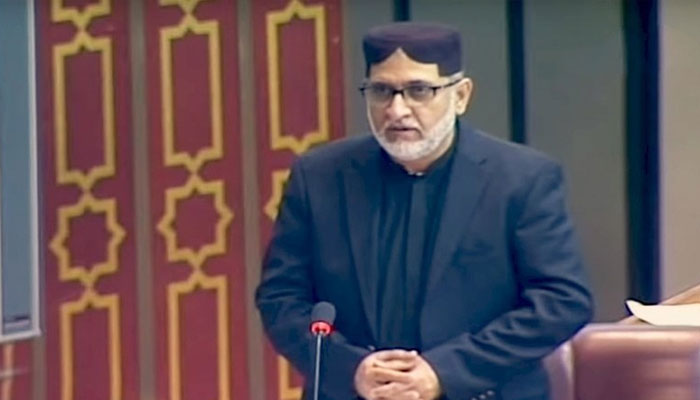
National Assembly Speaker Ayaz Sadiq on Wednesday accepted the resignation of veteran Baloch politician Sardar Akhtar Mengal, chief of the Balochistan National Party-Mengal (BNP-M), bringing an end to months of uncertainty surrounding his status in the lower house of Parliament.
Mengal, who was elected as an MNA from Khuzdar (NA-256) in the 2024 general elections, had submitted his resignation in September 2024, citing the “prevailing situation in Balochistan” as the reason for stepping down.
Reacting to the acceptance of his resignation, Mengal criticised the ruling Pakistan Muslim League-Nawaz (PML-N), the speaker’s party, for delaying the decision.
“PML-N has at last accepted my resignation after dragging its feet long enough to expose its own fear,” Mengal said in a post on X (formerly Twitter).
“Was it the applause that unsettled you or the fact that I could draw crowds in Punjab’s core?” he added, apparently referring to his participation in a discussion on Balochistan at the Asma Jahangir Conference recently held in Lahore.
Criticism at Asma Jahangir Conference
During the conference, Mengal criticised recent political and electoral developments in Balochistan, alleging that mainstream Baloch political leadership had been sidelined. He also raised concerns about restrictions on political activity, curbs on media access and shrinking civil liberties in the province.
In his latest social media post, Mengal emphasised that he had not availed himself of any financial benefits after tendering his resignation.
“For the record, not one rupee has been withdrawn since my resignation. Every amount remains in Parliament’s bank. The lodges were vacated 17 months ago and I have not resided there since. Adios!” he wrote.
Background to the Resignation
Mengal had stepped down following heightened security tensions in Balochistan, particularly after the deadly attacks across the province on August 26, 2024, and amid growing protests over enforced disappearances.
At the time, both the government and the Pakistan Tehreek-i-Insaf (PTI) had urged him to reconsider and continue representing Balochistan in Parliament, describing his presence as crucial for voicing the province’s concerns at the national level.
Travel Ban and Court Intervention
In July 2025, Mengal was barred from travelling abroad when immigration officials at Quetta airport informed him that his name had been placed on the Provisional National Identification List (PNIL), effectively imposing a temporary travel ban.
However, two months later, the Balochistan High Court declared the restriction illegal and directed authorities to lift the ban immediately.
‘Marginalised and Ignored’
In his resignation letter addressed to the NA speaker, Mengal stated that the “prevailing situation in Balochistan” had compelled him to resign.
“Our province has consistently been marginalised and ignored by this House. Each day, we are pushed further against the wall, leaving us with no choice but to reconsider our roles,” he wrote.
He argued that the lack of genuine representation for the people of Balochistan in the Assembly had rendered voices like his ineffective.
“It has become increasingly clear that our attempts to speak or protest are met with hostility; our people are either silenced, labelled as traitors, or worse, killed,” the letter stated.
“Under such circumstances, I find it impossible to continue in this capacity, as my presence here no longer serves any purpose for the people I represent.”
The acceptance of Mengal’s resignation marks a significant political development, particularly at a time when tensions in Balochistan remain high and debates over representation, security policies and civil liberties continue to shape the national discourse.
-
Sindh Home Minister Warns Kachha Robbers Amid “O...
Sindh Home Minister Zia Lanjar warns Kachha robbers: “Lay down arms or face death.” 78...
-
Balochistan CM Sarfraz Bugti: No One Allowed to Ta...
Balochistan CM Sarfraz Bugti warns against terrorism, says only the state has the right to...
-
Khawaja Asif Rebukes Achakzai, NA Adopts Resolutio...
Defense Minister Khawaja Asif condemns Achakzai’s “force of four districts” remark, ...
-
Khawaja Asif Signals Action Against Terrorists in ...
Defense Minister Khawaja Asif warns terrorism from Afghanistan will be addressed before Ra...
-
PTI Condemns Alleged Abduction, Torture of Lawyer ...
PTI has condemned the alleged abduction and torture of Supreme Court lawyer Ali Zaman and ...