WORLD NEWS
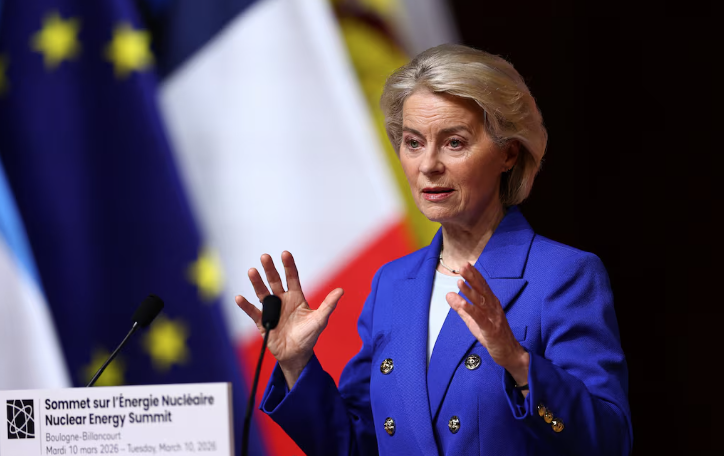
European Commission President Ursula von der Leyen has described Europe’s long-term reduction in nuclear energy as a “strategic mistake,” warning that the decision has left the continent overly dependent on expensive and volatile fossil fuel imports amid the ongoing energy crisis exacerbated by the US-Israeli war on Iran.
Speaking at an energy conference in Paris on Tuesday, von der Leyen highlighted that nuclear power accounted for roughly a third of Europe’s electricity in 1990, but its share has dropped to just 15% today. She argued that this decline has compromised Europe’s energy security and exposed it to global fuel market shocks.
“Being completely dependent on expensive and volatile imports puts Europe at a disadvantage compared to other regions,” von der Leyen said. “This reduction in the share of nuclear was a choice. I believe it was a strategic mistake for Europe to turn its back on a reliable, affordable source of low-emissions power.”
The comments reflect ongoing debates in Europe over balancing renewable energy expansion with the need for stable, low-carbon electricity. Germany’s Environment Minister Carsten Schneider criticised von der Leyen’s position, arguing that renewables such as wind and solar provide cleaner, safer, and increasingly affordable electricity.
Despite such criticism, von der Leyen announced that the European Commission would offer a €200 million guarantee for private investments in innovative nuclear technologies, funded through the EU carbon market. This move signals growing EU interest in nuclear energy as part of its long-term energy strategy.
France, Europe’s largest nuclear energy producer, has advocated for greater nuclear investment to maintain industrial competitiveness. President Emmanuel Macron called for international cooperation to diversify uranium supply and proposed standardising reactor designs across Europe to support the domestic nuclear industry. Customs data shows that France imported 39% of its enriched uranium from Russia in 2025, highlighting ongoing supply vulnerabilities.
Some EU countries, including Denmark and the Netherlands, have recently softened opposition to nuclear energy, while Austria and Luxembourg remain opposed. The EU budget does not directly fund nuclear projects due to a lack of unanimous support among member states.
The debate over nuclear energy is closely tied to Europe’s broader energy security concerns, especially following past crises such as Russia’s 2022 gas cuts after its invasion of Ukraine. Analysts say the EU may now pursue a nuclear renaissance to reduce reliance on imports and stabilize power supplies for heavy industry.
-
Trump Blames Advisors for Iran Conflict, Warns of ...
Trump blames Kushner, Witkoff & Hegseth for Iran escalation. Claims Iran “would have att...
-
Qatar Maintains Diplomatic Channel with Iran Amid ...
Qatar says communication with Iran remains open despite rising Gulf tensions. PM held one ...
-
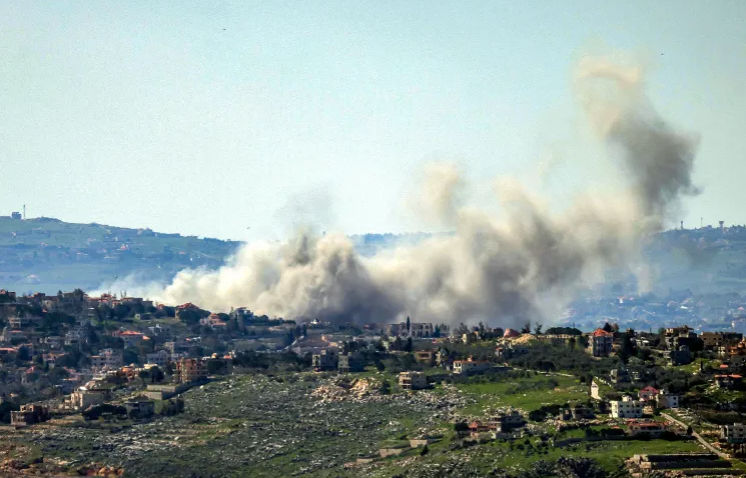
Israel Launches Airstrikes on Southern Lebanon Ami...
Israeli airstrikes hit Tyre, Beirut suburbs, and southern Lebanon targeting Hezbollah, lea...
-
EU’s Antonio Costa Says Russia Is Only Beneficia...
European Council President António Costa warns that Russia is the sole country benefiting...
-
Helicopter Crash in UAE Kills Two Armed Forces Per...
A UAE helicopter crashed due to a technical fault, killing two military personnel. The Min...